Sacred places
16/08/25 01:11
Whenever we visit dear friends, our conversation includes remembering other friends who have passed away. One of the things we share is respect and admiration for some incredible people. We say the names of those we have known, and we tell stories of those who have gone before us. One of the reasons we travel is that community transcends space. We continue to belong to people who are in different places. When we go to those places, we remember others who have lived and died. Our community transcends time. We belong to a people who have gone before us, and we belong to those who will come after us.
The Black Hills of South Dakota are familiar to us. We lived here for 25 years. We loved showing them to guests and visitors. When friends from distant places visited, we drove them around the hills so they could see the natural beauty of the place. Now that we have moved to another place, we become the guests as we revisit places we know and see things from a new perspective. Since time immemorial, people have come to this place for rest and renewal. The hills are sacred not only to the Lakota, but to dozens of indigenous plains tribes. We, who have had the privilege of living in this sacred place, are shaped by the holy ground upon which we have stood.
Yesterday we took a drive around some of the southern hills. We began our tour with a visit to the Remembering the Children memorial site. It has been created to protect, honor, and remember the children who died at the Rapid City Boarding School. There are dark moments in our history. Led by indigenous tribal members, the community has worked together to preserve the truth of what happened at the site. Sculptor Dale Lamphere worked with ideas from survivors and children to create a powerful sculpture for the memorial. We had to view it from a respectful distance because the monument is temporarily closed as the complex network of tribal, city, state, and private land ownership is navigated to develop and preserve the site properly.
Later, we walked among the rock pinnacle formations known as Cathedral Spires. Some people climb to the top of the rocks, but we have been content to walk around and among them, viewing their grandeur from the paths. The ancient stones have inspired people for tens of thousands of years and will continue to invoke awe and wonder from visitors for generations yet to come. Walking among them is a reminder that our time is but a brief moment in the story of this place. That moment, however, is significant. In that moment, we realize the importance of caring for this land, and we also recognize the importance of keeping this land accessible to all. Custer State Park was established because people understood that these places should remain in public control. There are places where private ownership is appropriate. However, the establishment and continued maintenance of the park is an acknowledgement that some lands must remain public and accessible to all.
The park continues to change. We stopped at a new visitor center that we had not seen when we lived in the hills. It contains well-done displays of the creatures and sights of the park. Funds from public and private sources have been combined to create a legacy for future generations of park visitors.
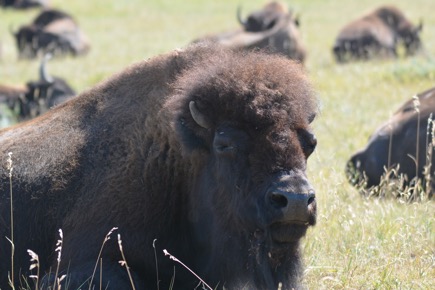
The bison, however, survive. Starting with a small remnant herd in the 1930s, the park has managed and nurtured the free-roaming bison into a substantial herd. Through careful management, including an annual roundup, so that the health of the herd can be assessed and vaccinations given to protect them. There is also a yearly auction to control the size of the herd to levels that can be sustained within the park.
The rocks and animals of Custer State Park stand as reminders of the past we have inherited and the sacred lands and animals that we must preserve for future generations.
One of the Lakota words that we learned in our years of living in the hills is “Takini.” The word might be translated, “survivor,” though a more precise translation would be “barely surviving.” It is the name of the place alongside the Cheyenne River where the survivors of the Wounded Knee massacre stopped in exhaustion on their journey north in search of support from relatives at Green Grass and Standing Rock. Our friend Matt Iron Hawk once told me, after a long silent pause, that Takini means “We’re still here.”
Despite the ravages of time and the cruelty of human systems, the sacred remains. The rocks are still here. The bison are still here. And the people are still here. Indigenous and settler people have shaped the history of the hills and remain the reason we have returned and will return again.
These hills are indeed sacred, infused with the memory of those who have gone before. We have been privileged to know some incredible and influential people. We have inherited the whole history of our people, both good and bad. And we are still here. But we are here only for a little while. These hills do not belong to us. They belong to the future. May the things we do while we are here leave a lasting legacy for those who will follow.